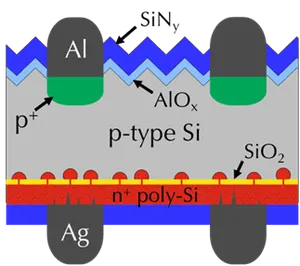
With the energy transition, expectations for the reliability of photovoltaic modules are rising. Alongside high efficiency, resistance to environmental stress is gaining importance, especially to UV radiation. TOPCon and HJT technologies in particular show noticeable efficiency losses after prolonged exposure. Our research group from the Artemis project, together with centrotherm international AG, investigated how this stability can be improved and published the results in a new study.
The key factor is the fabrication of the aluminum oxide layer used for passivation in solar cells. The study compared two established processes:
- Plasma-enhanced chemical vapor deposition (PECVD)
- Tube-type plasma-enhanced atomic layer deposition (PEALD)
Mini-modules with p-type back-junction solar cells were examined, each with different front-side passivation layers. AlOx layers produced by PECVD were compared with those produced by PEALD. Both processes were implemented within the same tool concept so that differences could be attributed to the deposition itself.
The modules were tested under a UV load of 146 kWh/m², corresponding to around four years of real solar exposure in Germany.
Key results
- POLO-BJ cells with PECVD AlOx/SiNy stacks showed power losses of up to 27 %
- POLO-BJ cells with PEALD AlOx/SiNy stacks showed losses of only 2.5 %
- The low degradation stabilized after an initial exposure of 26 kWh/m²
- Cells with PEALD layers showed no reduction in open-circuit voltage
- Lifetime measurements confirmed that PECVD layers are more sensitive to short-wavelength UV radiation at 313 nm
Why is this important?
- UV stability can be improved directly at the cell level
- PEALD can be integrated into existing tube PECVD systems
- No need for UV-absorbing or UV-converting foils
- Longer module lifetime, higher reliability, lower power degradation
The results show that the PEALD process provides a robust, industry-ready approach to increasing the long-term stability of solar cells, representing an important step toward improving the reliability of future PV technologies.