Passivating contacts for TOPCon solar cells: Understanding and hands on practice - An intensive course at ISFH for professionals
Intensive course on poly-Si contacts for TOPCon solar cells
Poly-Si contacts such as POLO and TOPCon are a key building block of current and next-generation silicon solar cells. Their successful implementation in industrial environments requires a deep understanding of processes, material properties, and the interaction between research developments and fabrication steps to device performance.
This training program is designed for professionals in the photovoltaic industry who work on the development, scale-up, or production of solar cells with poly-Si contacts. It combines focused theory with hands-on work in ISFH’s production-near SolarTeC infrastructure, enabling participants to analyze real processes, interpret measurement data, and address typical challenges encountered in industrial practice.
Participants gain knowledge that supports stable process control, targeted troubleshooting, and informed decision-making in R&D, pilot lines, and manufacturing.
Upon successful completion of the course for professionals, participants will receive a Micro Degree certificate in “Passivating contacts for TOPCon solar cells” (5 ECTS) from Leibniz University Hannover. Micro Credentials and Micro Degree programmes are recommended by the European Union as qualification measures and are internationally recognised.
Who should attend?
- Process engineers in PV cell manufacturing
- R&D staff working on silicon solar cells
- Researchers transitioning technologies from lab to pilot or production scale
- Professionals aiming to deepen their understanding of poly-Si contact technologies
Learning objectives
After completing the training, participants will be able to:
- Explain the physical principles and design concepts of poly-Si contacts in solar cells
- Fabricate and characterize poly-Si contacts using industrially relevant tools
- Evaluate how variations in process parameters affect electrical and optical performance
- Systematically analyze process deviations and derive mitigation strategies
Added value for industry
Participants benefit from:
- Direct interaction with ISFH researchers
- Training content aligned with current PV production challenges
- Practical knowledge applicable to both R&D and manufacturing environments
- Exchange with peers facing similar technical questions
Training concept
The program follows a structured approach:
- Theory and background
Fundamentals of solar cell physics with a focus on passivation and contacts, current best-known methods, and characterization techniques.
- Hands-on sessions
Practical work in ISFH’s SolarTeC 2.0, including process demonstrations and measurements.
- Data analysis and discussion
Interpretation of measured data, comparison with reference results, and discussion of typical production issues.
Training environment
SolarTeC is ISFH’s production-near research infrastructure, offering access to process and characterization tools that reflect current industrial standards. Those are
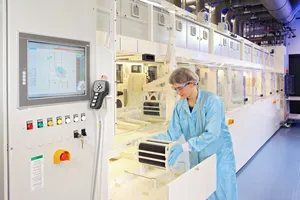
Hands-on learning using industrial production equipment
The training involves working directly with industrial process equipment and learn how to monitor critical fabrication steps. Process experts detail how individual process stages influence solar cell quality and efficiency, and how to detect and address process deviations in production environments.
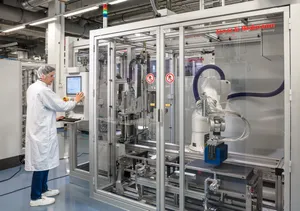
Automation and process control in production lines
Participants will learn how robotic handling, machine interfaces, and monitoring tools support stable production. The training focuses on interpreting process data, adjusting equipment settings, and maintaining consistent performance in industrial fabrication lines.
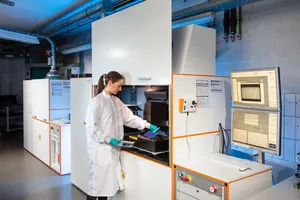
Solar cell analysis in a production-relevant environment
As part of the training, participants work with characterization equipment and analyze solar cells under real measurement conditions to evaluate process parameters and cell performance.
How to apply
Interested in the course? Register your interest and we'll keep you informed about upcoming dates and registration.