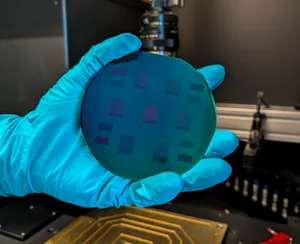
ISFH develops 3T-capable POLO²-IBC silicon bottom cell for enhanced bandgap flexibility and energy yield
Perovskite-silicon tandem cells represent the next logical step in advancing high-efficiency solar cells beyond single-junction silicon. In conventional 2-terminal cells, the subcells are connected in series and must carry the same current. The lowest current limits the entire device. Achieving optimal performance therefore requires current matching, typically by selecting a wide-bandgap perovskite composition. However, such materials tend to show instabilities under illumination and heat, including phase segregation. In addition, changes in sunlight conditions during the day or across seasons disturb current balance and reduce efficiency.
In collaboration with KIT and LUH, ISFH presents a promising solution: the 3-terminal tandem configuration. For this purpose, ISFH developed a POLO²-IBC silicon bottom cell with optimized recombination properties. The 3T architecture eliminates the need for current matching in conventional 2T tandems, enables flexible perovskite bandgaps from 1.52 to 1.73 eV, and increases annual energy yield, particularly in regions with high solar irradiance.
The 3T architecture with ISFH expertise
Within the 27+6 project, ISFH developed an innovative POLO²-IBC silicon bottom cell specifically designed for integration into 3T tandem architectures. The cell features a textured nPOLO front side, an ITO recombination layer, and optimized rear contacts based on nPOLO and pPOLO. Recombination current densities of all POLO contacts were reduced to approximately 1 to 2 fA/cm². The resulting bottom cells achieved carrier lifetimes comparable to 26 percent efficient single-junction POLO cells.
The tandem performance reported in the publication is based on high material and process quality. Silicon bottom cells fabricated at ISFH were processed with perovskite top cells at KIT. Compatibility with established POLO-IBC technologies underlines the potential for industrial scaling.
Performance data and system behavior
The 3T tandem cell achieves an efficiency of 30.1 percent. In 2T operation, only 24.6 percent is reached due to current mismatch losses, although cell architecture and perovskite bandgap remain identical. The efficiency of 2T tandems depends strongly on precise current matching, as shown by comparing perovskite bandgaps between 1.52 and 1.73 eV. Deviations from the optimal bandgap of around 1.7 eV significantly reduce overall performance. The 3T architecture maintains nearly constant performance across this range.
Simulations of annual energy yield under real climate conditions confirm this advantage. In Phoenix, the annual output of the 3T cell reaches 546 kWh/m², compared to 513 kWh/m² for the 2T variant. With a suboptimal bandgap, the difference can increase to 89.5 kWh/m² per year. The 3T architecture compensates more effectively for spectral fluctuations occurring over the course of a day or year.
These results demonstrate that the three-terminal architecture overcomes key physical limitations of conventional 2T tandem cells while enabling higher real-world energy yields.
The results presented are the outcome of close collaboration between KIT, ISFH, and LUH. We thank all project members of 27+6 for their contribution to this technological advancement.
Key results at a glance
Record efficiency: Demonstration of a 3T tandem cell with 30.1% efficiency.
Material flexibility: The 3T architecture removes the current-matching constraint between subcells, enabling the use of perovskite top cells with lower bandgaps and potentially higher stability.
Optimized bottom cell: ISFH developed a specialized silicon process with a textured nPOLO front side and POLO rear contacts. The contacts achieved recombination current densities of only 1–2 fA/cm², matching the level of 26% high-efficiency cells.
Spectral resilience: In contrast to 2T cells, 3T systems respond significantly less sensitively to changes in the solar spectrum.
Relevance
The energy transition requires high-efficiency PV modules that operate reliably in the field for over 25 years, not only under laboratory conditions. The currently dominant 2T architecture often forces researchers to select less stable perovskite compositions to achieve current matching. The demonstrated 3T solution shows that potentially more stable perovskite compositions can be used in tandem solar cells without sacrificing efficiency.
Contribution of ISFH
ISFH developed a novel 3T-capable POLO²-IBC silicon bottom cell featuring:
• Textured nPOLO front side
• ITO recombination layer
• nPOLO and pPOLO rear contacts
• Recombination current densities of 1–2 fA/cm²
• Carrier lifetime comparable to 26% POLO single-junction cells
This bottom cell forms the basis for the achieved 3T tandem efficiency of 30.1%.