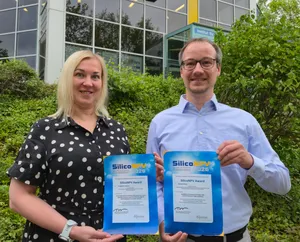
At the international SiliconPV conference held in Ankara, Turkey, in April 2026, Dr. Yevgenia Larionova and Dr. Michael Winter were honored with the SiliconPV Award. Both researchers presented their work in talks to the international photovoltaic research community.
The two awarded contributions address key challenges in modern solar cell technologies, ranging from higher efficiencies to long-term operational stability. Their research contributes to the development of more powerful and cost-effective photovoltaic systems for the next generation.
SiliconPV Awards 2026:
Precise SiOx layers for passivating contacts
Dr. Yevgenia Larionova received the award for her contribution “Atomically precise interfacial SiOx grown by a novel separate-precursor-pulse PECVD technology for passivating poly-Si on oxide contacts”.
Her work focuses on ultra-thin silicon oxide layers which, together with a polycrystalline silicon layer deposited on top, form so-called passivating contacts in modern solar cells that enable high conversion efficiencies. The process allows precise and uniform coating of large solar wafers and is suitable for industrial manufacturing.
Stability of Ga-doped Cz-Si solar cells under field conditions
Dr. Michael Winter received the SiliconPV Award for his contribution “Stability of Ga-doped Cz-Si Solar Cells under PV-Module Field conditions”.
His work investigates how long-term stability results obtained in laboratory test samples translate to solar modules operating under realistic field conditions. The results show that performance losses of solar modules under typical operating conditions in Northern Europe remain low. For regions with higher module temperatures, the solar cell process can be adapted easily to achieve negligible degradation under those conditions as well.