Systematic Underestimation: Why the role of photovoltaics in energy scenarios must be reassessed
Solar energy in the global energy mix: An analysis of 60 Scenarios
The energy transition is well underway, but are we looking at the future with the right numbers? A new systematic literature review shows that photovoltaics (PV) are set to become the dominant energy source of the 21st century, yet this development is still often underestimated when outdated data are used.
In the scientific debate on achieving the Paris climate targets, there is broad agreement that solar and wind will form the backbone of the future energy system. However, opinions diverge widely on how large the share of solar energy will actually be. In our recent study, conducted in collaboration with Leibniz University Hannover and LUT University Finland, we analyzed 60 global transformation scenarios and challenge overly pessimistic assumptions.
Analysis of 60 studies focusing on fully renewable systems
The study focuses on research modeling energy systems with at least 95 percent renewable energy in the electricity sector. Only scenarios were included that consider not only electricity generation but also at least heat and transport. This approach enables a realistic assessment of the role of solar energy within the overall system.
A total of 60 studies meet these criteria and form the basis of the analysis. The models examined range from global scenarios to regional analyses. In addition to the results, the underlying assumptions on costs, technologies, and modeling approaches were systematically evaluated.
Wide range of results, but a clear overall trend
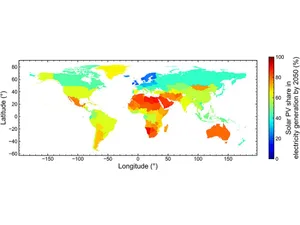
The analysis shows a significant range in the share of solar energy in electricity generation. Depending on the study, this share varies between 5 and 98 percent by 2050. Despite these differences, a clear overall trend toward high shares of solar and wind energy emerges.
In most scenarios, both technologies together reach shares between 80 and 99 percent. Lower values can usually be explained by specific regional conditions, such as high hydropower potential or other renewable sources. In some cases, energy imports or modeled constraints also play a role.
The results also show that geographic factors have a decisive influence. Regions with high solar irradiation tend to have higher shares of solar energy. At the same time, the analysis demonstrates that even under comparable site conditions, large differences can arise when different modeling assumptions are applied.
Why many energy models underestimate solar energy
A central finding of the analysis is the systematic underestimation of solar energy in many studies. Several causes can be identified:
1. Outdated cost assumptions
Some studies use investment costs for photovoltaics that are too high. Around 18 percent of the analyzed studies assume costs above €500/kW even in 2050, although these values are already being undercut today.
2. Simplified modeling
About one-third of the studies consider only generic PV systems. Technologies such as:
- tracking systems
- floating PV
- building-integrated PV
are often not included, even though they can significantly increase system contribution.
3. Missing sector coupling
Models without integration of Power-to-X technologies underestimate the role of solar energy. These technologies enable:
- energy storage
- use in industry and transport
- integration of hard-to-electrify sectors
Studies with comprehensive sector coupling show significantly higher solar shares.
4. Low temporal and spatial resolution
Models with coarse temporal resolution cannot adequately represent the variability of solar energy, leading to distortions in system evaluation.
This makes it clear that the role of solar energy cannot be assessed in isolation. It depends strongly on its integration into the overall energy system and aligns well with future system requirements.
Implications for energy policy and research
The results highlight how strongly energy supply scenarios depend on underlying assumptions and perspectives. Differences between studies cannot be explained solely by data or regional conditions, but also by how technologies are prioritized and represented within models.
For policymakers and researchers, this creates a key task: not only to compare model results quantitatively, but also to systematically reflect on their underlying assumptions. This includes examining which technological developments are considered likely and how strongly certain options are represented.
The analysis also shows that narratives in energy research play a structuring role. They influence which scenarios are considered plausible and which developments are emphasized in strategic considerations. Evaluating these narratives helps to better interpret differences between studies and to make the range of possible developments more transparent.
For political decision-making, this means that energy scenarios should not be viewed in isolation. Comparing different modeling approaches provides a way to identify robust trends and address uncertainties in a targeted manner.
Findings from the energy studies examined
• 80–99% of electricity from solar and wind
• Global solar energy share of 61% by 2050
• Solar energy share varies significantly depending on location and model assumptions
• Power-to-X significantly increases the share of solar energy
Why is an analysis of narratives relevant?
• Scenario studies form the basis for energy and climate policy
• Misguided decisions based on flawed models must be avoided
• Prioritization of infrastructure and investments should be targeted
• The energy transition will be more cost-effective with more solar energy
Gaps in the models and the need for action
• Outdated cost assumptions in many studies
• Inadequate representation of PV technologies
• Lack of integration of sector coupling
• Need for higher temporal and spatial resolution