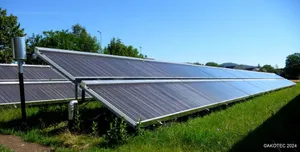
The integration of large-scale solar thermal systems into district heating networks is considered a key option for reducing fossil-based heat generation. In Germany, however, such systems face specific boundary conditions. Existing networks require high supply temperatures, while large seasonal storage systems have so far only been implemented in isolated cases. Against this background, the study examines how solar thermal plants are currently designed and which operational effects result from these configurations.
The study analyzed 38 plant concepts from feasibility studies as well as 30 realized or under-construction solar thermal plants using high-efficiency evacuated tube collectors with collector areas exceeding 1,000 m². The investigated projects include both rural and urban district heating networks and therefore represent a large share of Germany’s installed large-scale systems.
Network temperatures in planning and operation
A central focus of the study is the required summer and winter supply temperatures, as they largely determine the conditions under which solar heat can be integrated into district heating networks.
- In the evaluated feasibility studies, summer supply temperatures are mostly between 70 and 80 °C
- In realized projects, summer temperatures between 70 and 90 °C are common
- Winter supply temperatures exceed 100 °C in more than 20% of the plants
The median summer network temperature is 75 °C in feasibility studies and 80 °C in realized projects, which aligns well with findings from earlier Austrian studies. The analysis shows that these temperature levels are well suited for the application of high-efficiency evacuated tube collectors.
Dimensioning of collector fields and thermal storage
In addition to network temperatures, the study also investigated the sizing of collector fields and thermal energy storage systems. To compare plants of different sizes, the solar fraction and the specific storage volume relative to collector area were analyzed.
- Solar fractions are often between 17 and 20%
- Typical storage sizes range from 90 to 100 l/m² of collector area
- More than 60% of realized plants use storage volumes below 100 l/m²
One key finding is the nonlinear relationship between solar fraction and storage demand. The regression analysis shows that doubling the solar fraction from approximately 15 to 30% requires about a tenfold increase in storage volume. This relationship applies to both feasibility concepts and realized plants.
Large seasonal storage systems, common in Danish district heating systems, are still rare in Germany.
Occurrence of stagnation in large-scale plants
A major focus of the study is the analysis of stagnation, meaning the shutdown of the solar circuit under high solar irradiation and insufficient heat demand. This condition typically occurs during summer when storage systems are fully charged and the network cannot absorb additional heat.
The analysis revealed the following observations:
- Plants with a solar fraction of around 20% show an average of about 25 stagnation days per year
- The observed range extends from approximately 13 to 50 days
- Stagnation occurs particularly often in systems with small storage volumes and high solar fractions
The results indicate that stagnation is a regular operating condition in many realized plants rather than an exception.
In addition to the statistical evaluation, a solar thermal plant with around 6,000 m² of collector area was analyzed in detail. The system supplies a district heating network with an annual heat demand of approximately 16 GWh and has a storage capacity of only 40 l/m².
Measured operational data showed:
- An achieved solar fraction of around 13%
- At least 38 stagnation days within one year
- Collector temperatures above 150 °C during stagnation periods
Based on these findings, the storage capacity was later increased by 35 l/m². In addition, adjustments to the control strategy were recommended, as conventional heat generators continued feeding heat into the network despite solar surpluses.
Implications for planning, research, and regulation
The study highlights two key aspects. First, stagnation is a structural result of current system design practices. This has implications for planning guidelines, funding schemes, and technical concepts. Second, prevailing network temperatures are generally suitable for the use of high-efficiency evacuated tube collectors, while realized storage capacities remain limited relative to collector area.
To further increase solar fractions, significantly larger storage systems, including seasonal storage, are required. Stagnation and the resulting overheating of the solar circuit are regular operating conditions in many plants. The detailed monitoring analysis confirms these relationships under real operating conditions.
Achieving climate targets will require a broad roll-out of such technologies. Solar district heating systems must become more efficient in planning, implementation, and operation. Intelligent stagnation management through advanced collector technologies and optimized control strategies could play a key role.
The related papers are available here:
https://link.springer.com/chapter/10.1007/978-3-032-09844-3_4
https://www.tib-op.org/ojs/index.php/ST-symposium/article/view/2747
What is stagnation?
Stagnation describes the operating condition of a solar thermal system in which the solar circuit pump stops despite available solar irradiation. This occurs when the generated heat can no longer be absorbed, for example because district heating demand is low during summer and the thermal energy storage (TES) has reached its maximum capacity. The fluid remaining inside the collector overheats to the point of evaporation, placing the entire system under high thermal stress and pressure.
Key findings of the study
Network temperatures: Most systems feed heat into the network at temperatures between 75 °C and 80 °C.
Storage capacity vs. solar fraction: Doubling the solar fraction often requires a tenfold increase in storage volume.
Stagnation challenge: Systems with a 20% solar fraction experience between 13 and 50 stagnation days per year.
Practical example: Monitoring of one plant showed collector temperatures reaching 151 °C during stagnation after shutdown of the collector field with fully charged storage.
Why our research matters
Stagnation is not merely a side effect, but a critical design factor. Safe management of stagnation is essential to simplify planning and implementation, extend system lifetime, and reduce costs.
The study highlights two possible solutions:
Technical prevention: The use of heat pipe collectors, such as those developed in the HP-BIG project, physically and inherently limits maximum temperatures to around 130 °C, reducing the risk of overheating.
Cost reduction: Limiting maximum stagnation temperatures enables the use of less temperature-resistant but significantly cheaper materials, such as plastic piping. The potential savings in piping costs are estimated at around 30%.