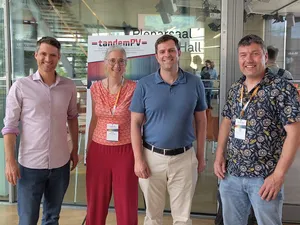
The development of perovskite-silicon tandem solar cells continues to advance at a rapid pace. Questions regarding industrial manufacturing and long-term stability therefore took center stage at this year's tandemPV Workshop 2026 in Berlin. The conference was held at the Academy of Arts near the Brandenburg Gate and provided a platform for exchange between leading research institutions and industry partners. More than 200 participants from 21 countries attended this year's international conference. ISFH was represented by Prof. Dr. Robby Peibst, Verena Steckenreiter, Dr. Joachim Vollbrecht, and Dr. David Hinken, who presented current research results on the calibration, fabrication, and stability of perovskite-silicon tandem solar cells.
Advances in calibration, manufacturing processes, and stability
In his presentation, "Calibration of large-area tandem devices at ISFH CalTeC," Dr. David Hinken presented recent work on the calibration of large-area tandem solar cells. As cell sizes continue to increase, the demand for precise and reproducible measurement methods is growing. ISFH supports customers and partners with its expertise in calibration, enabling more reliable characterization of large-area tandem devices and contributing an important building block for the industrial implementation of this technology.
Two poster presentations on perovskite processing and stability enhancement
The ISFH poster presentations also attracted considerable interest. Verena Steckenreiter presented her work, "Hybrid process using inkjet printing of organic perovskite components: correlation of 'quasi-in situ' X-ray diffraction and JV analysis." Her research focused on hybrid fabrication processes in which organic perovskite components are deposited by inkjet printing. By combining quasi in situ X-ray diffraction with electrical characterization, correlations between crystal formation and solar cell performance were investigated. The findings provide important insights into the development of scalable manufacturing processes for perovskite tandem solar cells.
Dr. Joachim Vollbrecht presented the poster, "Thiophene ethylammonium triggered 2D perovskite formation and its impact on solar cell performance." The work showcased results from the NextGenPV collaborative project, conducted together with the Institute of Inorganic Chemistry at Leibniz University Hannover and the Helmholtz-Zentrum Berlin. The research demonstrates how deliberately engineered 2D/3D perovskite heterostructures can improve the open-circuit voltage of perovskite solar cells. This addresses one of the key challenges on the path toward durable and high-performance tandem solar cells.
ISFH would like to thank the organizers of the tandemPV Workshop, especially Helmholtz-Zentrum Berlin (HZB) and PSE Conferences & Consulting GmbH, for hosting a successful event and fostering intensive scientific exchange.