State of Lower Saxony strengthens heat pump testing capabilities at ISFH
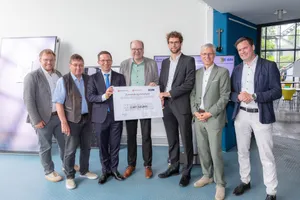
State of Lower Saxony strengthens heat pump testing capabilities at ISFH
- Planned new testing environment will increase the accuracy, speed, and energy efficiency of heat pump testing
- Contribution to the heat transition and the advancement of climate-relevant technologies in Lower Saxony
Emmerthal, June 2, 2026 – The Lower Saxony Ministry for the Environment, Energy and Climate Protection (MU) and the Lower Saxony Ministry for Science and Culture (MWK) are funding the research project CHAWAEL at the Institute for Solar Energy Research Hamelin/Emmerthal (ISFH) with approximately €1.5 million. The project aims to establish a highly dynamic and energy-efficient testing environment for the characterization of air-source heat pump systems.
CHAWAEL (“Highly Dynamic and Energy-Efficient Test Environment for the Characterization of Air-Source Heat Pump Systems”) will create a new infrastructure for testing air-source heat pumps under realistic operating conditions. The objective is to achieve greater measurement accuracy while reducing both energy consumption and testing time. This will enable more comprehensive and targeted applied research on energy efficiency in both prototype and series developments. The project is expected to improve the comparability of different heat pumps and heat pump systems and support further increases in system efficiency.
Christian Meyer, Lower Saxony’s Minister for the Environment and Energy, said:
“Lower Saxony is Germany’s leading heat pump state. The use of heat pumps reduces dependence on fossil fuel imports and ensures stable heating costs through renewable energy. In 2025, more heat pumps than fossil-fuel oil and gas heating systems were installed in Germany for the first time. With more than 35,700 approved funding applications and €600 million in investments in 2025, Lower Saxony ranks first nationwide in funding per capita. Heat pumps are the backbone of the heat transition, make a substantial contribution to achieving climate targets, and create thousands of jobs in industry and skilled trades. This is why the state strongly supports the heat transition.
At the same time, even good technology must continue to evolve so that the next generation of heat pumps becomes even more efficient. This requires comprehensive testing and analysis of the systems. To further strengthen ISFH’s expertise in this field, we are pleased to support the CHAWAEL project through funding from the Ministry of Energy’s ecological section of the Economic Development Fund.”
Falko Mohrs, Lower Saxony’s Minister for Science and Culture, stated:
“As a state, our goal is to ensure a secure, affordable, and sustainable energy supply for people. Through the CHAWAEL project, we are strengthening applied energy research in Lower Saxony. The new testing infrastructure at ISFH opens up entirely new experimental possibilities for investigating and improving heat pumps under realistic operating conditions with greater precision and efficiency. This accelerates the transfer of scientific findings into practical applications and creates an important foundation for the next generation of climate-friendly heating systems.”
Maximilian Loth, Project and Group Leader for Heat Pumps at ISFH, added:
“The infrastructure developed through this project will enable us to determine the behavior and efficiency of heat pumps under real operating conditions in much greater detail. We would like to thank the State of Lower Saxony for supporting this project. Efficient heat pumps are an important pillar of the heat transition. They reduce energy costs for households and require lower investments in the electricity grid.”
Heat pumps play a central role in achieving climate-neutral heating. The heating sector is responsible for around 40 percent of Germany’s CO₂ emissions and approximately 56 percent of final energy consumption. In recent years, air-source heat pumps have accounted for more than 90 percent of the market. However, existing testing procedures only partially reflect real operating conditions. CHAWAEL addresses this challenge by improving testing methodologies through dynamic test conditions and more precise control of environmental parameters. The testing environment will directly couple the heat pump under test with the test bench and regulate temperature and humidity at short intervals. Instead of relying on large climate chambers, the airflow will be conditioned in a targeted manner. A model-predictive control system will continuously adapt testing conditions to the operation of the heat pump, enabling faster acquisition and evaluation of performance data.
The benefits of CHAWAEL extend far beyond testing technology. The expected research results are highly relevant to the transformation of the energy system into a smart grid, which places new demands on heat pump systems. Smart grids are intended to function as flexible, efficient, and decentralized energy management systems that balance electricity generation and consumption in real time. This offers opportunities to better connect energy producers and consumers while contributing to supply security. The findings from CHAWAEL are expected to improve the interaction between heat pumps and the broader energy system and enhance control strategies.
The project will strengthen ISFH’s testing capabilities while providing important impulses for the further development of testing standards. By the end of the three-year funding period, an intelligent and resource-efficient testing environment for residential heat pumps is expected to be available, enabling more precise determination of heat pump efficiency characteristics.